“Great companies are built on great products.”
In 2017, Elon Musk’s automobile company, Tesla, became one of the world’s most valuable car companies. The electric-car manufacturer’s market value came in at $56.1 billion, with GM close behind at $51.6 billion.
Tesla may be the talk of the town today, but it is just one in a long line of automobile manufacturers. Back in 1885, Carl Benz developed the first automobile. Known as the Benz Patent “Motorwagen”, his creation is considered by many as the birth of the automobile. It certainly changed transportation history forever.
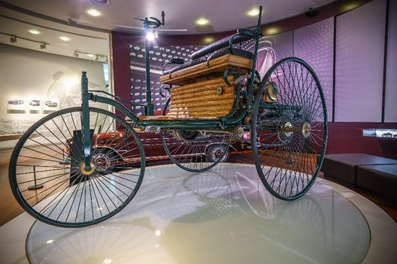
The "Motorwagen" changed the way people moved.
Over one hundred years after Benz developed his Motorwagen, the automobile remains the dominant form of transportation across the United States. With the world's reliance on motor vehicles, there is a strong demand for new car production, along with parts manufacturing to keep older cars on the road through regular repairs and maintenance.
Today's automotive and motor vehicle manufacturing industry is one of the top employment industries in the world. From Tier 1 and Tier 2 parts suppliers to factories and assembly lines to the repair and maintenance of vehicles, the automotive industry is critical to the global economy's health and indirectly supports millions of jobs.
Within each automotive sub-industry, there is great demand for personal protective equipment, or PPE, which is where MCR Safety enters the picture. MCR Safety recognizes how important knowledge and information is in keeping workers safe from workplace hazards, which is why we've assembled a variety of automotive resources in one spot.
Automotive Industry Resource Pages
Across all of MCR Safety’s Automotive Industry pages, we highlight each specific industry, employment numbers, worker activities performed, potential hazards, and, most importantly, the safety gear necessary to help keep automotive workers safe. You can either jump directly to the areas of automotive that apply to you, or you can stay on this main page for a macro overview of this very important industry.
Here are the six different industries highlighted across MCR Safety's Automotive Industry pages:
Engine Manufacturing
NAICS Code: 33631
Explore
Parts Manufacturing
NAICS Code: 3363
Explore
Repair and Maintenance
NAICS Code: 8111
Explore
Tire Manufacturing
NAICS Code: 32621
Explore
Trailer Manufacturing
NAICS Code: 3362
Explore
Vehicle Manufacturing
NAICS Code: 3361
Explore
Automotive Economics and Its Impact on Other Industries
The automotive industry is an excellent barometer and gauge for overall economic activity. This is because it affects multiple industries, from the materials going into vehicles to the aftermarket support in keeping them running. In fact, in a recent PBS Frontline documentary, a Chinese car manufacturer notes that the car industry is representative of an entire country's industry, a bellwether of it's economic performance. The automotive industry involves the assembly of all technologies: cybersecurity, electrical, lighting, mechanical, and software. All industries must be strong before an automobile can be built, meaning a country is highly advanced.
In addition, manufacturing motor vehicles requires immense resources. Large quantities of materials from other industries go into building vehicles. These materials include steel, iron, aluminum, carpeting, textiles, rubber, plastics, and glass. According to the American Chemical Council, plastic encompasses about 50% of the construction of a new car. It is used in places like door handles, dashboards, seat belts, and air conditioner vents.
Most automobiles still rely on petroleum to operate, making vehicles still the lifeblood of the oil and gas industry.
Worldwide Motor Vehicle Production
You hear a lot in the news today about how automotive manufacturing is leaving the U.S. Well, one may want to also pause and reflect on the fact that this is happening as worldwide production is at an all-time high. In 2000, there were 58 million vehicles produced. In 2018, there was a total of 95 million vehicles produced. That is over 38% growth during an eighteen year period
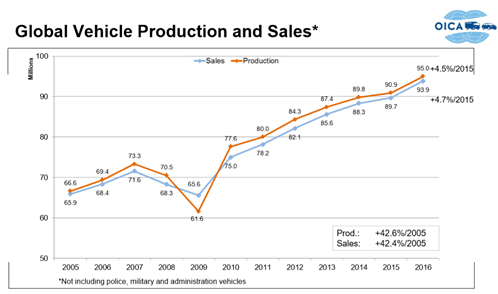
By 2040, cars are projected to reach two billion, with most of the growth taking place in China and India. This projected number means car manufacturing will continue to increase for decades to come. As you can see in the charts below, China's automotive market production is a big reason for the overall growth.
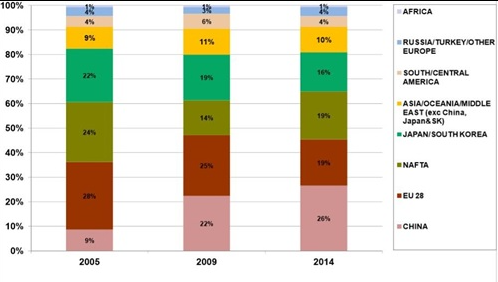
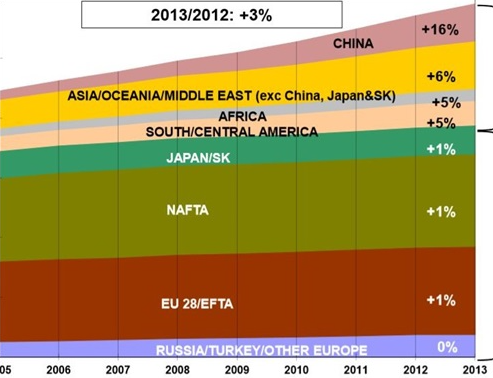
New Vehicle Sales Shares by Region Vehicles in Use: Growth by Region
Key Companies
The automotive industry is comprised of some of the world's largest companies. The largest automakers in the U.S., known as "The Big 3", are Ford, GM, and Chrysler. However, many of the world's largest automotive companies have their own production operations in the U.S., which ultimately means they create U.S. jobs.
Here is a look at the top automotive companies employing the most workers.
| Company |
Worldwide Employees |
| Volkswagen |
642,000 |
| Nissan |
450,000 |
| Toyota |
369,124 |
| Fiat Chrysler |
235,915 |
| Honda North America, Inc. |
208,000 |
| Ford Motor Company |
199,000 |
| General Motors Company |
173,000 |
| Hyundai |
104,731 |
| Tesla, Inc. |
45,000 |
| Suzuki |
45,000 |

OICA's Worldwide Employment Numbers by Country
U.S. Employment Numbers
The automotive industry creates jobs, jobs, and more jobs. The American Automotive Policy Council highlights that the auto industry supports a total of nearly 8 million American jobs. These jobs are found in a wide range of facilities: laboratories, factory floors, assembly lines, engine plants, metal stamping, and dealerships. When you examine automotive manufacturing, The Big 3 make up more than 66% of U.S. auto industry jobs.

Production positions still make up a large percentage of workers.
| Industry |
Employment |
NAICS |
| Automotive repair and maintenance |
886,600 |
8111 |
| Motor vehicle parts manufacturing |
654,700 |
3363 |
| Motor vehicle manufacturing |
236,500 |
3361 |
| Motor vehicle body and trailer manufacturing |
178,800 |
3362 |
| Total workers: 1,956,600 |
Employment by specific NAICS
Work Activities
There are a wide variety of jobs to be found in the automotive industry. Machines and humans work together, with machines helping, not replacing, humans. The heartbeat of any factory is the employees who perform the work. With close to 2,000,000 laborers performing specialized jobs, there are a multitude of different tasks performed.
Processes like forging, stamping, bending, forming, welding, machining, and assembling are all used to manufacture and maintain motor vehicles. All of these processes involve fabricating metal, which means our Metal Fabrication industry page is an excellent additional resource for automotive safety managers and workers.

On each sub-industry page, we highlight the specific activities that pertain to that particular automotive sector. Here are just a handful of the hundreds of activities performed across this industry.
- Adjusting small parts and screws
- Assembling bolts
- Assembling components like dashboards, panels, and seats
- Attaching cables
- Body trimming
- Connecting devices
- Electrical component and wire harness assembly
- Feeling fine parts
- Removing dents
- Smoothing body surfaces
- Straightening vehicle frames
- Welding
- Moving metal workpieces
- Removing dies
- Replacing broken windshields and glass
- Adjusting and installing machinery
- Repairing equipment and machinery
- Deburring
- Handling molded parts
- Inspecting parts
- Finishing
- Inspecting and touching vehicles for defects
- Inspecting for unnecessary burrs
- Laboratory quality inspection
- Aligning parts
- Working with sharp metal
- Cutting, shaping, and forming metal
- Handling rough, jagged, and ultra-fine sharp parts
- Degreasing
- Maintaining production machines
- Changing machine gears
- Changing parts
- Checking and inspecting parts
- Machinery maintenance
- Transporting materials
- Preparing components for assembly
- Assembling and disassembling equipment
- Overhauling engines
- Handling metal panels
- Handling sharp metal parts formed from the presses
- Machine-press operation
- Cutting, shaping, and forming metal
- Fabricating metal parts
- Machine-press operation
- Applying adhesive coatings and sealers
- Applying sealers
- Polishing workpieces
- Positioning workpieces
- Spraying paint
- Surface treatment
- Touching up
- Removing puncturing objects
- Assembling machine fixtures
- Repairing dies and tools
- Assembling metal parts of the body
- Repairing dies and tools
- Adding material to metal workpieces
- Filling holes and seams of fabricated metal products
- Heat treating metal products
Occupations
-
Assemblers and Fabricators
-
Mechanic
-
Metal and Plastic Workers
-
Body Repairer
-
Inspectors, Testers, Sorters, Samplers, and Weighers
-
Painting Workers
-
Welders, Cutters, and Fitters
-
Laborers and Material Movers by Hand
-
Helpers - Production Workers
-
Cutting, Punching, and Press Machine Setters
-
Industrial Maintenance Workers
-
Machinists
-
Tire Builders
-
Machine Tool Cutting Setters and Operators
-
Extruding and Drawing Operators
-
Industrial Machinery Mechanics
-
Molding, Coremaking, and Casting Operators
-
Construction Trade Workers
-
Tool and Die Makers
-
Electricians
-
Tire Repairers and Changers
-
Mixing and Blending Machine Setters, Operators, and Tenders
-
Cutting and Slicing Machine Setters, Operators, and Tenders
-
Grinding, Lapping, Polishing, and Buffing Machine Operators
-
Structural Metal Fabricators and Fitters
-
Millwrights
-
Plumbers and Pipefitters
-
Plating and Coating Machine Setters
-
Forging Operators
-
Lathe and Turning Machine Operators
-
Rolling Machine Setters and Operators
-
Fiberglass Laminators and Fabricators
-
Heat Treating Operators
Safety
Performing work safely in the automotive industry is imperative, as injuries can occur at any time during the manufacturing and maintenance processes. The multitude of different tasks performed, whether in automotive shops, body shops, or on factory floors, require workers to wear PPE at all times.
The Bureau of Labor Statistics (BLS) incident numbers shown below clearly indicate that safety measures must be a high priority for all workers. However, some automotive sub-industries need to be extra cautious. Trailer manufacturing and vehicle manufacturing are essentially twice as dangerous as all other U.S. automotive sub-industries.
| Sub-Industry |
Total Recordable Cases for Every 100 Employees |
| Motor vehicle body and Trailer manufacturing |
6.9 |
| Motor vehicle manufacturing |
6.4 |
| Tire manufacturing |
3.8 |
| Motor vehicle parts manufacturing |
3.7 |
| Engine and engine parts manufacturing |
3.6 |
| Automotive repair and maintenance |
2.6 |
| Average for All U.S. Industries: 3.1 |
Even though assembling cars is more technologically driven than ever before, worker injuries are still a major concern. The good news is that incident rates have been coming down, as shown in the image below.
As we mentioned earlier, Elon Musk is quoted as saying, "Great companies are built on products!" Yes, we've won some awards over the years for some really cool new products, but ultimately, we know that it's you, the consumer, who determines which companies make great products. One thing we can say for certain is that the products our industry makes are great because they aid in keeping you from getting hurt.
At MCR Safety, we're dedicated to creating the very best PPE products. We want to see the above BLS injury stats keeping coming down, which ultimately means we're doing our part in bringing leading-edge PPE technology to market.
An automotive worker's most important tools are the ones he or she was born with: eyes and hands.
At MCR Safety, We Protect People!


